
J. Hoffmann Bon bon bowl holder silver-plated brass Viennese secession Deco 1900
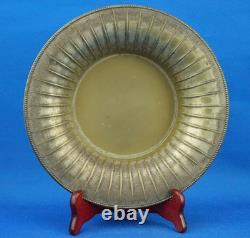
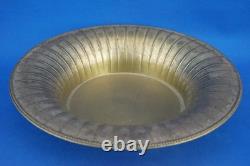
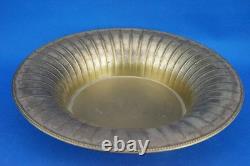
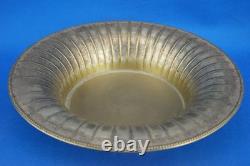
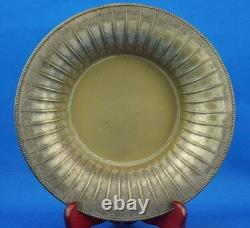
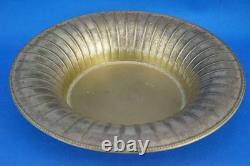
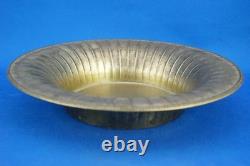
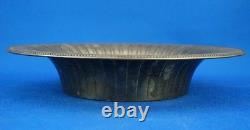
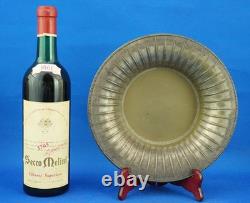
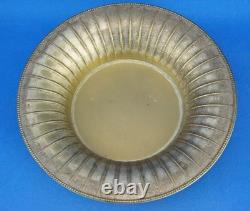
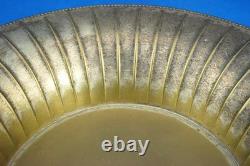
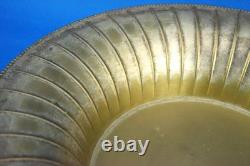
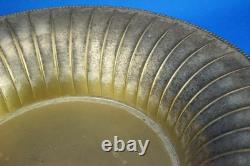
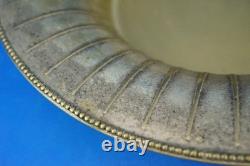
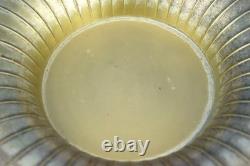
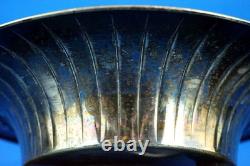
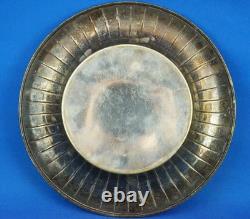
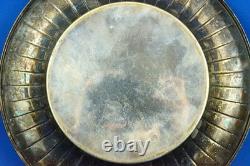
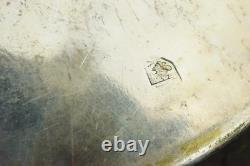
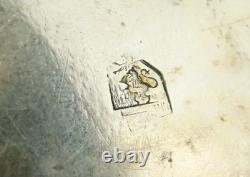

Diameter : 9,45 inch ; Height : 1,97 inch ; Weight: 0,74 lbs. Diameter: 24 cm; Height: 5 cm; Weight: 0,334 Kg. Wonderful silver-plated brass bonbon holder, decorated on the brim with equidistant raised lines and raised beading, on the edge, marked under the base with a rampant lion and under a barely legible writing, it seems WER... Although the mark is very similar to the Sheffield mark of the rampant lion used in Scotland, in Glasgow, from 1819 to 1964, I believe that the paternity of this object can be attributed to the Wiener Werkstatte manufacture, specifically to Josef Hoffmann, one of its founders and greatest exponents. In fact, the style of the bonbon holder is very similar to those made by this artist, as the material used, silver-plated brass, was often used by the artist and finally also the writing under the lion Wer... " could stand for "Werkstatte, for all these reasons it is highly probable that we are talking about a piece made by Josef Hoffmann for the Wiener Werkstatte. The object can be dated to the first decades of the 20th century and the evident patina present confirms our dating. The bonbon holder is in full Deco style and takes up the canons of the Viennese secession. In the history of art, secession (in German Secessionstil) refers to the development of artistic styles, developed between the end of the 19th century and the beginning of the 20th century, in Munich and Berlin in Germany and in Vienna in Austria. The officialization of this movement occurred with the so-called Wiener Secession (Viennese Secession), which consisted in the creation of an association of 19 artists, painters and architects, including Josef Hoffmann himself, who broke away from the Academy of Fine Arts to form an autonomous group, with its own independence and even its own headquarters: the Viennese Secession Building. Useful information for the evaluation of the object. While objects very similar to ours, always by Josef Hoffmann who created many objects in silver metal, from baskets to glasses, from bowls, to saucers etc. Josef Franz Maria Hoffmann (Brtnice, 1870 - Vienna, 1956) was one of the greatest Austrian architects, active between the end of the 19th century and the first half of the 20th century.
Hoffmann is considered one of the greatest ceramists and artists of the Viennese secession, he founded the Wiener Werkstatte together with Koloman Moser and absorbed the Wiener Keramik of Michael Powolny, with whom he collaborated for many decades. In 1987 the Museum für angewandte Kunst (MAK) in Vienna organized an exhibition in his honor. The museum still presents a permanent exhibition of his works and also special exhibitions are conceived on the architect and his contemporaries. PORCELAINS, CERAMICS, TERRACOTTE, BRONZE, PAINTINGS, FURNITURE, GLASS AND MUCH MORE AS, FOR EXAMPLE. For each object there may be multiple advertisements in different countries: USA, Italy, France, United Kingdom, etc.
REMEMBER TO PUT ME IN THE FOLLOWING SELLERS LIST. Double box with a lot of bubble wrap around the object and a lot of soft material in the large cavities on all sides between the two boxes.